
Standing Water on an Asphalt Driveway: Causes, Risks and Solutions
PolyScellant · November 19, 2026
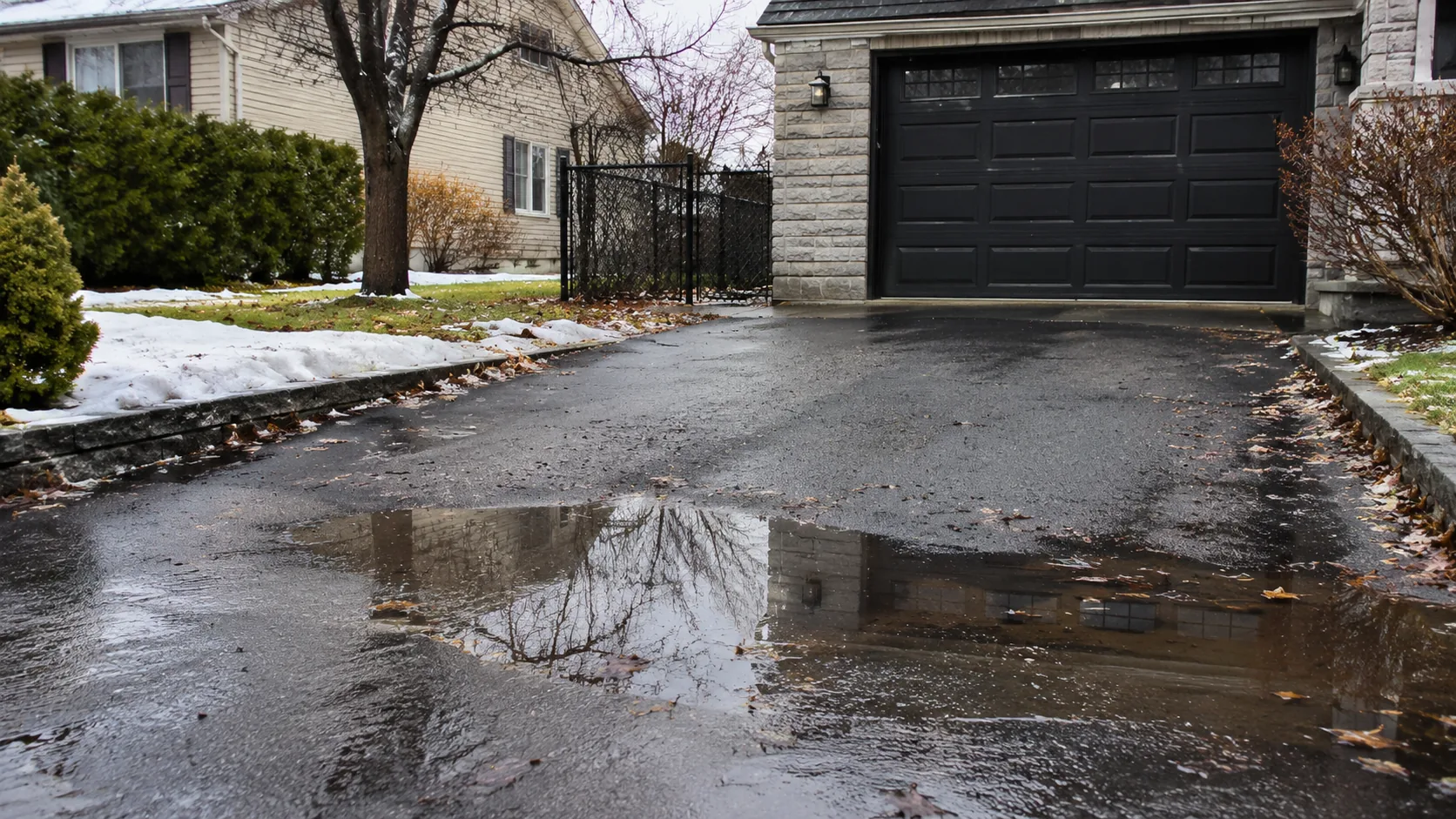
After rain, a puddle remains in the middle of your driveway. During a winter thaw, melting snow collects in front of your garage and then freezes into a patch of ice. Do you need to repave the driveway, install a drain, or simply clear a blocked water outlet?
A puddle does not automatically mean the driveway's foundation is damaged. The foundation is the layer of material, often crushed stone, that supports the asphalt. The right solution depends on where the water travels, the driveway's shape, and the condition of the materials beneath it.
In Vaudreuil-Soulanges, rain and winter thaws make it easier to see where water collects. Observing these areas can help you decide whether surface maintenance is appropriate or whether drainage work is needed to move the water away.
Why Does Water Collect on an Asphalt Driveway?
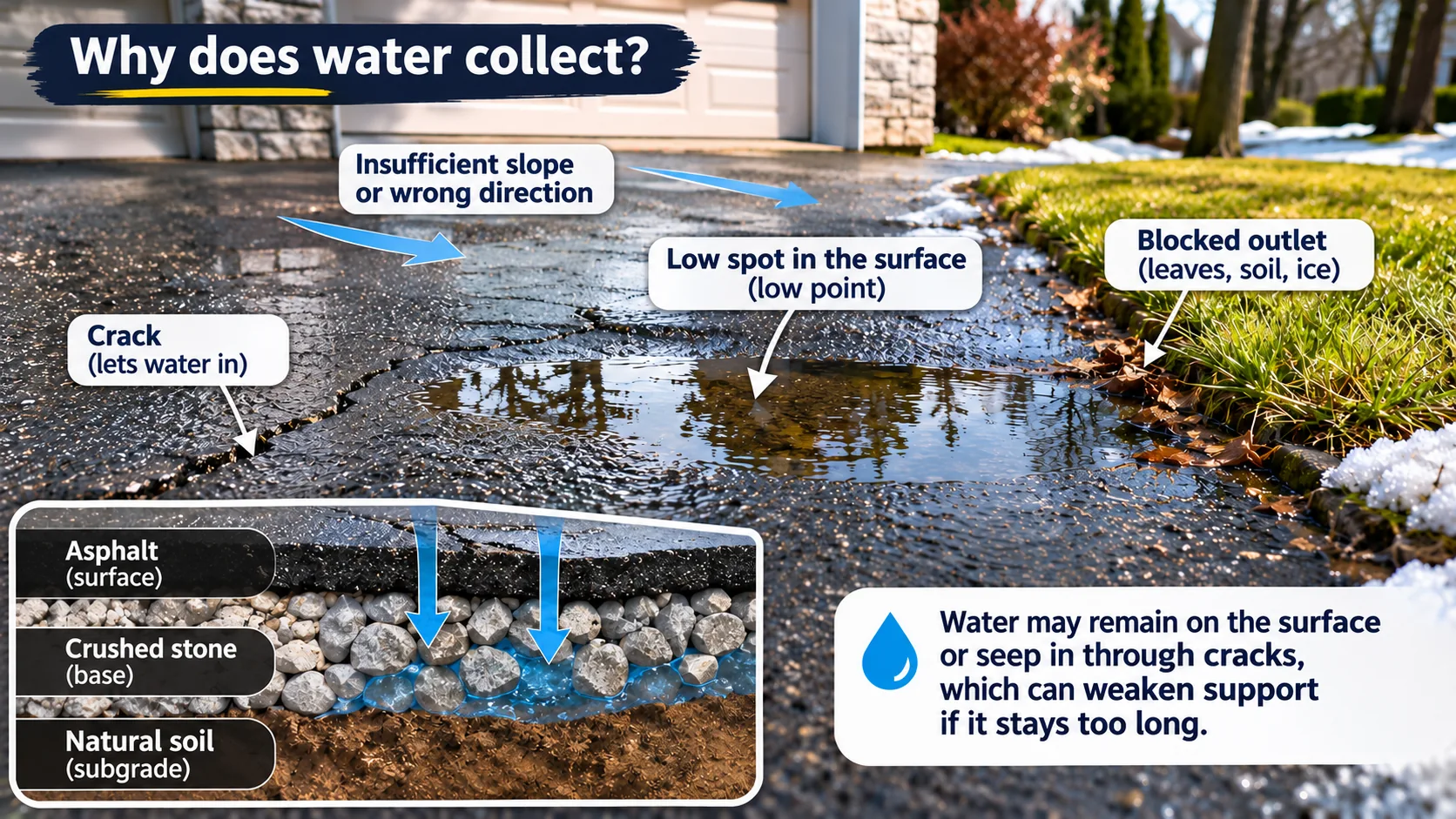
Not Enough Slope or a Depression in the Surface
Water needs a continuous downhill path to somewhere it can drain. If the driveway is too flat, slopes in the wrong direction, or has a low spot, water can become trapped.
CAA-Québec's residential asphalt guide, drawing on Bitume Québec's advice, recommends a 2% slope, or 2 cm per metre. This is a design guideline, not a mandatory slope for every driveway. Each property must be assessed on its own. Even a driveway with a suitable overall slope can have a depression that holds water. [1]
That depression may have been there since paving or developed later. The asphalt itself may have changed shape, or the layers beneath it may have settled. Materials that were not adequately compacted during construction can contribute to the problem. Water is not necessarily what caused the depression. [2]
A Blocked Outlet or Water Coming from Elsewhere
Sometimes water reaches the edge of the driveway but has nowhere to go. Built-up soil, plants, leaves, snow, or ice can block the exit. A flower bed or higher ground beside the driveway may also hold water back.
Look at what feeds the puddle, too. A downspout, the surrounding yard's slope, or melting snowbanks can all send water to the same spot.
The key is to see where water comes from, where it stops, and where it should go.
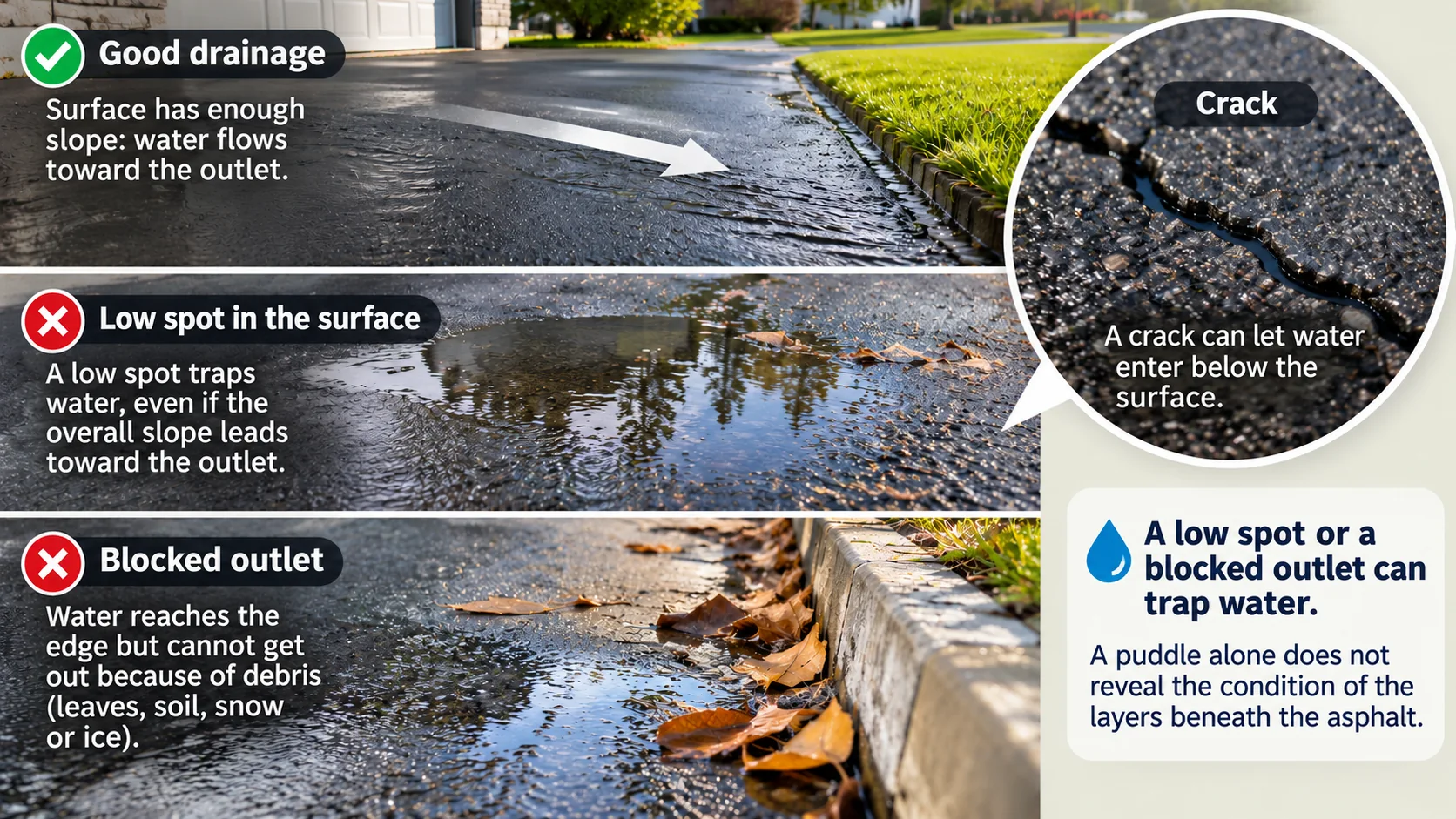
A low spot or blocked outlet can trap water. A puddle alone does not tell you whether the layers beneath the asphalt are damaged.
Small Puddle or Problem Worth Investigating?
Puddle size matters, but so do its location, how often it comes back, and whether it is getting larger.
| What You Notice | Suggested Next Step |
|---|---|
| A small isolated puddle, with no major cracking or visible changes | Photograph it and compare it after future rainfall |
| Water that keeps returning to the same place | Check where water enters, the low spot, and the outlet |
| A depression growing larger, connecting cracks, or loose pieces of asphalt | Have the asphalt and underlying layers assessed |
| Water approaching the garage or ice forming on a walkway | Have the drainage checked promptly |
This table helps you decide what to investigate. It does not replace an on-site inspection.
A puddle that remains for 24 or 48 hours does not, by itself, prove the foundation is damaged. Shade, temperature, humidity, and melting snow all affect how long water remains. Repeated pooling and changes in the surrounding asphalt are more useful warning signs.
What Happens When Water Gets Beneath the Asphalt?
Wet Base Materials May Provide Less Support
Water can enter through cracks, damaged areas, and open joints where two sections meet. It may also come in from the driveway's edges or from the soil below.
Beneath asphalt are usually layers of stone and then natural soil. Some of these materials become less firm when they contain too much water. As a result, they may support vehicle loads less effectively. [3]
That does not mean one visible puddle has soaked the whole foundation. Risk depends on the materials, the routes that let water in, and how easily the water can drain away.
How Québec's Freeze–Thaw Cycles Affect Asphalt
Some soils can rise when they freeze. If water is available and cold penetrates the soil, layers or pockets of ice may form. These are known as ice lenses.
During a thaw, the soil and materials beneath the asphalt may temporarily lose some strength. Poor drainage can make this worse. Vehicle loads may then contribute to surface deformation. [4]
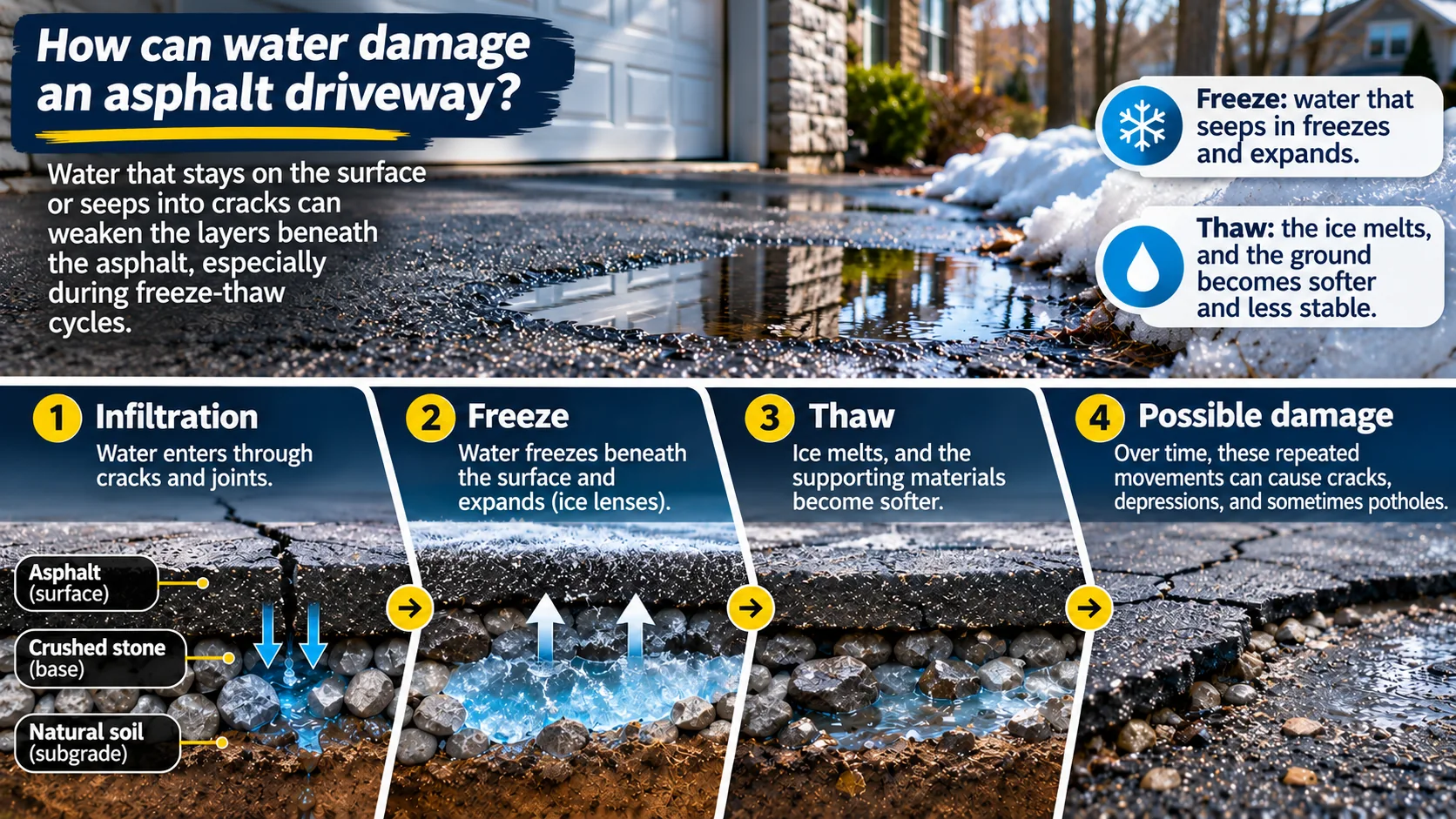
These movements may contribute to cracks and, in some cases, deterioration that eventually leads to potholes. Our article on freeze–thaw effects on driveway sealing explains the process further. For repair options, see our guide to potholes in asphalt driveways.
Why Do Depressions Form Under Parked Tires and Along Driveway Edges?
Asphalt Deformation or Settling Below?
A low spot where a vehicle is regularly parked can have several causes.
The asphalt itself can deform. Its resistance depends on the mix, compaction, and temperature. Vehicle weight and how long the vehicle stays in one place also matter. Under some conditions, repeatedly parking in the same spot can contribute to depressions. [5]
The layers beneath the asphalt can also settle or deform. They may have been inadequately compacted, may lack sufficient strength, or may be carrying loads beyond what they can support. Moisture can make some situations worse, but it does not explain every depression. [2]
A photograph shows the shape of the low spot. It generally cannot tell you which layer has moved.
Support Along the Driveway Edges
Asphalt edges can deteriorate more easily when the underlying materials do not support them adequately. Tires driving too close to the edge, poor drainage, and freezing may also contribute to damage. [2]
Adding concrete or paver edging does not automatically solve the problem. The edge still needs proper support, and water needs a way to drain.
What Can You Safely Check and Photograph?
After rain or during a thaw, observe the driveway from stable ground that is not icy.
To help with a future assessment:
- Take a wide photo showing the building and the direction water travels.
- Photograph the puddle close up, then photograph the same area when dry.
- Record the date, recent rainfall, and any melting snow.
- Estimate the puddle's size without stepping onto slippery areas.
- Identify cracks, downspouts, and accessible drainage outlets.
- Compare photos over several weeks: is the depression getting larger, or are more cracks appearing?
Remove accessible leaves and debris only when it is safe. Do not lift heavy drain covers or dig into the foundation to investigate. In freezing weather, do not hose down the driveway to test its slope; you could create ice.
In December, the priority is to keep the area safer, record what you see, and plan appropriate work. Our guide to preparing an asphalt driveway for winter offers more seasonal advice.
Which Solution Fits the Cause?
Clear the Water's Path or Improve Drainage
Start with what you can see. Sometimes an outlet covered in leaves simply needs to be cleared.
If water still returns with the outlet clear, the slope and sources of water need to be checked. Depending on the property, changing the surrounding landscaping or installing a drain may be necessary.
A drain only helps if it captures the water and carries it to an appropriate outlet. Both its location and discharge point require assessment. Adding a grate to a low spot is not enough on its own.
Correct the Surface, Repair a Section, or Rebuild the Foundation
A small depression may sometimes be corrected by restoring the surface to the proper level, provided the layers underneath are stable. If those layers keep moving, simply covering the low spot will not fix the cause.
Infrared asphalt repair is another option for some localized surface defects. A specialized heater softens existing asphalt so it can be reworked, levelled, and compacted, with fresh asphalt added where needed. This may suit small potholes or shallow depressions when the underlying base is sound. It cannot rebuild a failed foundation or, by itself, fix improper overall slope or drainage. PolyScellant does not currently offer this specialized repair service. Technical information about infrared repair.
Unstable underlying layers may need deeper repairs. Widespread damage can require rebuilding part or all of the driveway. But one isolated puddle is not enough reason to conclude that the whole driveway needs replacement. [6]
Before approving work, ask three questions: What is causing the problem? How will that cause be addressed? Where will the water go afterward?
What Sealer and Hot-Applied Crack Sealant Can Do
Driveway sealer is used to maintain a surface when its condition is suitable. According to the Blackmac product information, it can fill small surface voids and very fine, hairline cracks. This does not make the entire driveway completely waterproof, and it does not replace treatment for open cracks. [7]
Hot-applied rubber crack sealant is intended to reduce water entering cracks that are suitable for this treatment and have been properly prepared. It does not strengthen the foundation or raise a sunken section. Severely cracked areas or sections that move up and down may need other repairs. [8]
Learn more in our guide to repairing asphalt cracks before sealing and our asphalt crack repair service page.
Neither sealer nor hot-applied crack sealant fixes an incorrect slope, a sunken section, or a poorly designed drainage outlet.
Frequently Asked Questions
Does a Small Puddle Mean I Need to Repave the Entire Driveway?
No. It may be caused by a small depression or a blocked outlet. Check the driveway's condition and watch for changes before deciding on repairs.
How Long Can Water Sit Before I Should Worry?
Time alone is not enough to diagnose a problem. Watch whether the puddle keeps coming back, gets bigger, or is surrounded by new cracks. Water near the garage or ice on a walkway deserves prompt attention.
Why Does Water Collect Where I Park?
The asphalt or its supporting layers may have changed shape. Vehicle weight can play a role, but the location of a depression does not reveal its cause by itself.
Can Driveway Sealer Make Puddles Disappear?
No. A coat of sealer cannot raise a low spot or create a new drainage slope.
Does Hot Rubber Crack Sealing Fix Drainage Problems?
No. It can reduce infiltration through treated cracks, but it does not change where surface water flows.
Is a Drain in Front of the Garage Always the Best Solution?
No. First determine where the water comes from, why it reaches that spot, and where it can be discharged appropriately.
What Should I Do in December If Water Keeps Freezing in the Same Place?
Avoid the slippery area and clear accessible routes when it is safe. During a thaw, photograph where the water travels. If ice repeatedly forms in the same location, have the drainage checked.
Planning driveway maintenance in Saint-Lazare, Vaudreuil-Dorion, Hudson, Rigaud, Pincourt, or elsewhere in Vaudreuil-Soulanges? Describe the driveway's condition and where water collects when you request a quote from PolyScellant. We can assess whether surface maintenance or crack treatment is appropriate. Corrections to slope, drainage, or the underlying layers should be assessed separately by a qualified contractor.
Technical References
These resources explain the principles discussed above. The observation tips can help prepare for an assessment but do not replace an on-site diagnosis.
- CAA-Québec — Asphalt Driveway Technical Guide, archived by Bitume Québec (French).
- British Columbia — Pavement Surface Condition Rating Manual.
- FHWA — Geotechnical Aspects of Pavements, Chapter 3: Moisture and Support Materials.
- FHWA — Geotechnical Aspects of Pavements, Chapter 7: Frost Effects.
- Asphalt Institute — Engineering FAQs: Asphalt Loads and Deformation.
- Asphalt Institute — Repair of Asphalt Parking Lots and Driveways, Dwight Walker, 2008.
- McAsphalt — Blackmac Product Information and Download.
- InfraGuide — Guidelines for Sealing and Filling Cracks in Asphalt Concrete Pavement, NRC Archive.