
Asphalt Driveway Sealer Types: Cutback, Emulsion or Acrylic?
PolyScellant · November 19, 2026
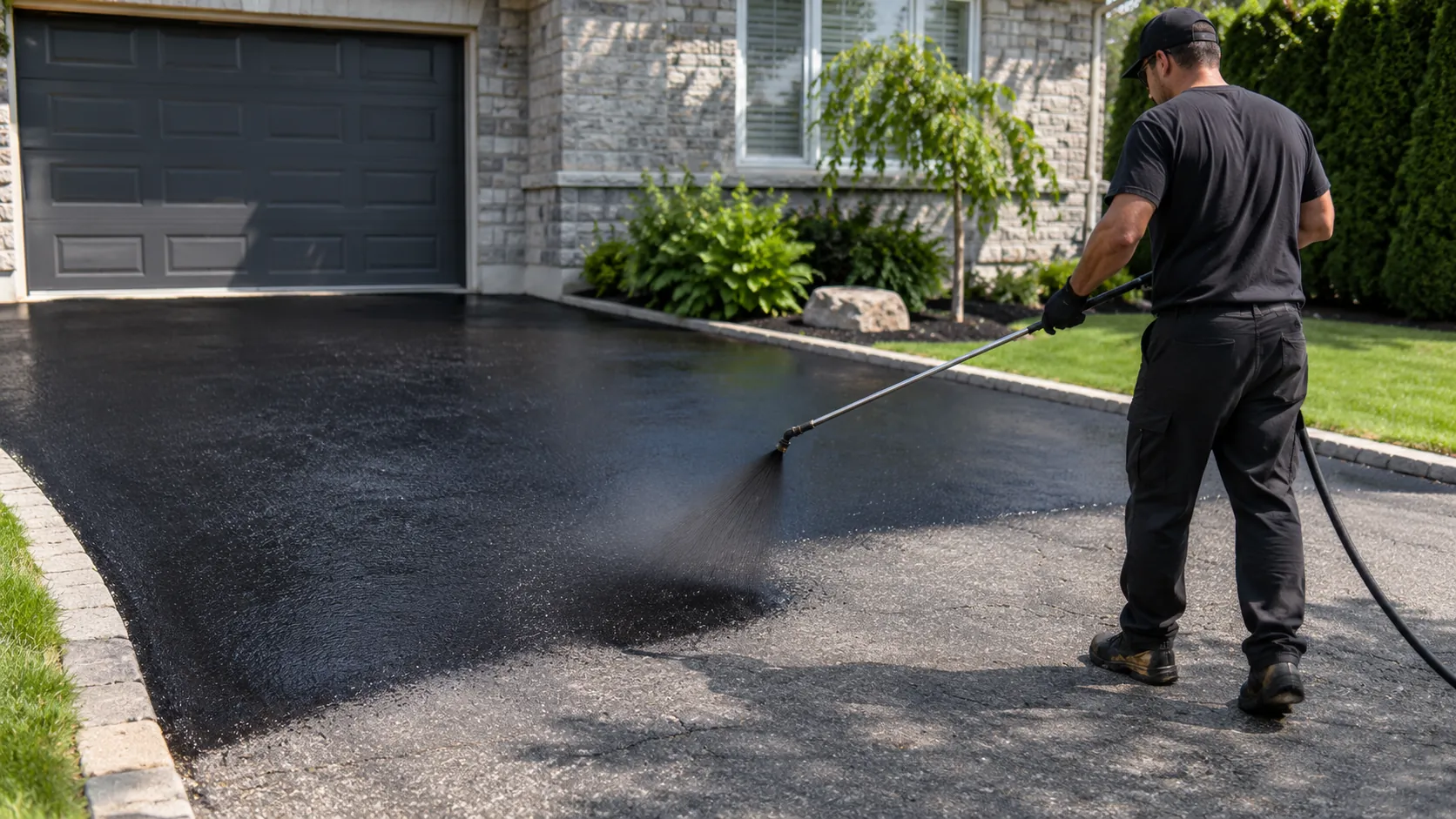
Two 17 L buckets both say “asphalt driveway sealer.” Both may leave a black finish. But one can contain asphalt binder dispersed in water, while another uses an acrylic resin. Their preparation, tools and drying times can be very different.
To make an informed choice, look at the binder, the liquid carrier and the condition of your driveway. The binder is what stays on the surface after drying. Ask for the full product name and technical data sheet.
What are the three main types of driveway sealer?
1. Solvent-based cutback asphalt sealer
Asphalt bitumen is the dark binder that holds the aggregate together in pavement. In a cutback sealer, a petroleum solvent makes the bitumen fluid enough to apply. The solvent then evaporates, leaving a bituminous layer. This is often what homeowners mean by “oil-based” driveway sealer.
Solvent-based products require precautions. Vapours may have an odour, release volatile organic compounds (VOCs) and present fire risks. Read the safety data sheet (SDS) for the exact product.
2. Asphalt emulsion sealer
An asphalt emulsion contains tiny droplets of bitumen dispersed in water with an emulsifier. As the water leaves, the bitumen forms a layer. A water-based sealer can therefore still contain asphalt. Some emulsions also use polymers, including latex. Surface preparation and drying requirements depend on the formula.
3. Water-based acrylic sealer
An acrylic resin forms a protective film as water leaves the coating. Some acrylic products contain no bitumen. Others may be asphalt emulsions modified with acrylic or other polymers. Words such as “latex,” “hybrid,” “acrylic-modified” and “100% acrylic” do not always identify the main binder. Check the specific product.
Side-by-side comparison of driveway sealers
This table describes common differences. It is not a universal performance ranking. Individual formulations and the manufacturer’s directions matter.
| Factor | Solvent-based cutback | Asphalt emulsion | Water-based acrylic |
|---|---|---|---|
| Binder | Asphalt bitumen | Asphalt bitumen, sometimes modified | Acrylic resin |
| Liquid carrier | Petroleum solvent | Water | Water |
| Preparation | Check pavement condition, stains and previous coating | Clean and follow surface instructions | Clean and verify compatibility |
| Application | Sprayer or squeegee, if approved | Squeegee, roller or approved equipment | Often roller; sometimes spraying |
| How it dries | Solvent evaporates | Water leaves and asphalt binder forms a layer | Acrylic resin forms a film |
| Water resistance | Depends on formulation and application | Depends on formulation and curing | Depends on film and product |
| Sun and UV | Check product-specific evidence | Performance varies by formula | Check product-specific evidence |
| Oil and gasoline | Do not assume universal resistance | Some formulas claim resistance | Some formulas claim resistance |
| Service life | Depends on surface, rate and wear | Depends on surface, rate and wear | Depends on compatibility, application and wear |
| Future recoating | Check compatibility | Check compatibility | Some products have specific restrictions |
| Safety and environment | Solvents, VOCs and fire precautions | Check ingredients, VOCs and SDS | Check additives, VOCs and SDS |
Which one lasts the longest? The available information does not support a universal ranking for every Québec driveway. A surface can still look black while the coating wears. A claim about oil resistance does not automatically prove protection against a long-lasting gasoline leak.
What is inside a 17 L bucket?
Two containers of the same size can hold very different products. One may contain asphalt emulsion, another acrylic resin. A roller or squeegee does not prove what binder is inside, and using a sprayer does not automatically make a product better.
For a concrete price example, Rust-Oleum Ultimate Driveway Sealer, 17 L, was listed at CAD $209.99 at Canadian Tire on November 19, 2026, according to the retailer listing checked. Prices can change. The “15-year” wording is a conditional commercial warranty, not proof that every driveway will last 15 years without maintenance. See the retailer listing.
Before buying, check the exact product number, stated coverage, number of coats, approved applicator, rain window, traffic restrictions and existing-coating compatibility. A consumer bucket may be a practical choice for a small driveway in good condition.
For a real-world cost comparison, read our professional-versus-DIY driveway sealing guide.
Which BLACKMAC does PolyScellant use?
PolyScellant uses McAsphalt BLACKMAC Cutback Asphalt Driveway Sealer, a solvent-based cutback bitumen product. It is not the same as BLACKMAC Emulsion Sealer, a separate asphalt emulsion product. When a quote simply says “BLACKMAC,” ask for its full product name and technical sheet.
Why PolyScellant chose BLACKMAC Cutback
We chose BLACKMAC Cutback because we believe it is an excellent fit for our preventive asphalt maintenance approach in Vaudreuil-Soulanges. We value a professional bituminous product with documented application requirements. We also appreciate working with an established Canadian manufacturer that has a facility in Salaberry-de-Valleyfield, close to the area we serve.
Our choice reflects the conditions Québec driveways face: water, sunlight, changing temperatures and snow removal. But a good product never replaces proper surface preparation. Porosity, existing coatings, application rate and weather all affect the result. That does not mean emulsions or acrylic sealers are poor products. Each should be judged by its formulation and intended use.
Learn more about our BLACKMAC choice and application method.
Application conditions are essential
McAsphalt documents an indicative application rate of about 0.4–0.8 L/m² for BLACKMAC Cutback, depending on the surface. Application temperature must be above 10°C. The driveway needs cleaning and appropriate treatment of oil stains. Rain should be avoided. The manufacturer specifies at least 24 hours before vehicle traffic, longer when drying is slow. Its flammable-solvent safety precautions must also be respected.
At PolyScellant, we start by assessing the driveway—not by promising a black finish. Surface sealer cannot replace repairs to serious cracks, potholes or failed foundations.
What about older coal-tar driveway sealers?
Coal tar and coal-tar pitch come from coal, while the asphalt bitumen discussed above comes from petroleum. Some coal-tar sealers contain polycyclic aromatic hydrocarbons (PAHs), which raise health and environmental concerns.
Canada’s Certain Products Containing Toxic Substances Regulations restrict the manufacture, import and sale of covered coal-tar sealant products and certain products exceeding a regulated PAH concentration. Restrictions took effect in 2025, subject to specified exceptions. This does not mean all petroleum-based solvent sealers are prohibited. Check the regulation and the exact code on any older product container.
Which sealer makes sense for Québec weather?
In Saint-Lazare, Vaudreuil-Dorion, Hudson and Rigaud, driveways face rain, sun, road salt, snow removal and freeze–thaw conditions. The sunny portion of a driveway may be far warmer than a shaded area. Cool or damp conditions can slow drying. Choose a product by its instructions and the actual pavement condition—not by a slogan.
A sealer maintains a suitable surface. It cannot fix incorrect drainage slope, a weak base or a pothole. For drainage concerns, read our standing-water driveway guide.
Frequently asked questions
Clear answers about sealer products and what makes them different.
Is every 17 L bucket water-based?
No. Container size does not identify the liquid carrier or binder. Check the exact code and product data sheet.
Does acrylic driveway sealer contain asphalt?
Not necessarily. Some products use acrylic resin; others are asphalt emulsions modified with polymers.
Do “acrylic-modified” and “100% acrylic” mean the same thing?
No. Modified may describe a polymer additive. “100% acrylic” may refer to the resin type, not the percentage of the whole bucket.
How can I tell which BLACKMAC is on a quote?
Ask for the full name. BLACKMAC Cutback is solvent-based. BLACKMAC Emulsion is a different water-based product.
Can I switch sealer types on a previously treated driveway?
Sometimes, but the existing coating and compatibility need to be checked before recoating.
Why are the rain and parking wait times different?
A surface may withstand some moisture before it can withstand vehicle tires. Follow both manufacturer instructions.
Does oil resistance also mean gasoline resistance?
Not automatically. Look for the substance tested, contact time and limitations.
Thinking about having your driveway sealed?
The right product depends on your asphalt and the preparation involved. PolyScellant serves Vaudreuil-Soulanges and can assess your driveway.
Request a free quoteTechnical sources
These sources explain the product families, manufacturer requirements and Canadian regulations. Always use the data sheet for the exact product code.
- McAsphalt — Driveway and parking lot sealing
- McAsphalt — BLACKMAC Cutback, product documents
- McAsphalt — Emulsion products
- Rust-Oleum Canada — Ultimate Driveway Sealer
- Canadian Tire — Rust-Oleum Ultimate 17 L
- Government of Canada — Regulations SOR/2025-36
- Government of Canada — Compliance guide
- Health Canada — Coal tars and distillates