
How long does asphalt driveway sealer last?
PolyScellant · Homeowner guide
How many years does driveway sealer really last? For the solvent-based Blackmac Cutback used by PolyScellant, Canadian contractors commonly describe a maintenance interval of roughly two to three years. That is neither a manufacturer warranty nor a requirement to reseal on a fixed schedule.
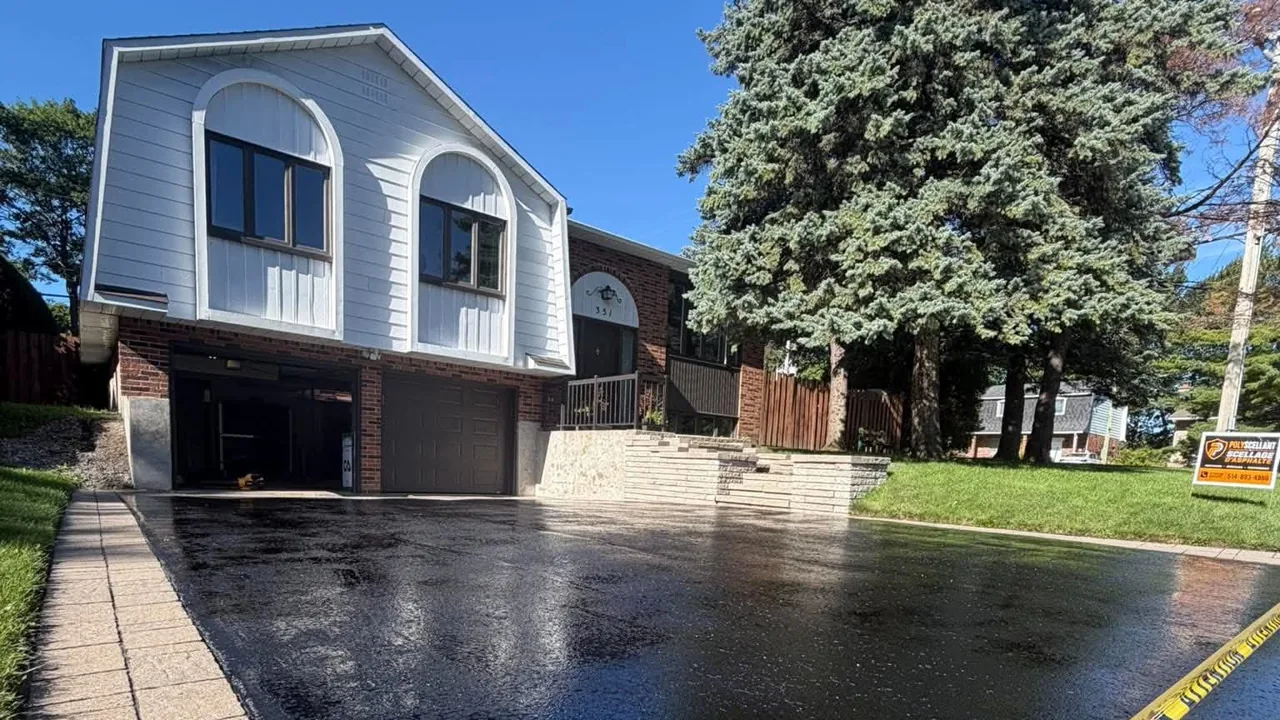
A contractor-reported maintenance estimate, depending on pavement condition—not a lifespan guaranteed by McAsphalt.
What the manufacturer confirms—and what it does not promise
McAsphalt Blackmac Cutback is a solvent-based bituminous treatment for preventive asphalt maintenance. On a properly prepared surface, it helps limit oxidation and moisture penetration.
The technical sheet does not promise a universal two-, three- or five-year lifespan. Porosity, initial pavement condition and everyday use all influence results.
Our approach: a driveway that is still in good condition does not automatically need another coat just because two years have passed.
Three different things homeowners often confuse
01 · Black appearance
Colour changes with sunlight, traffic and seasons. A less intense black does not, by itself, prove that all protection is gone.
02 · Surface condition
Look for texture changes, increased porosity, localized wear and deteriorating edges. Inspection matters more than the calendar.
03 · Cracks
A surface sealer is not a substitute for crack repair. Active cracks need to be assessed separately.
04 · Next application
Timing depends on whether the asphalt can properly receive the product—not just the desire for a uniformly black finish.
Why two driveways can age differently
In Vaudreuil-Soulanges, snowplows, freeze-thaw cycles, de-icing salt, sun exposure and vehicle traffic all affect wear. Tight steering areas and frequently driven sections may age faster than the rest of a driveway.
Preparation matters too: clearing dust and debris and choosing suitable weather help achieve an even application. Even a good product cannot make up for poor surface preparation.
Can Blackmac be applied too frequently?
Yes. McAsphalt emphasizes checking asphalt porosity. A surface already tightly sealed by previous applications may not absorb the treatment properly, potentially causing sealer tracking under tires. More coats are not automatically better.
How we decide whether a driveway is ready
- Inspect: look for faded, porous, cracked or winter-damaged areas.
- Review history: identify the previous product and application date when possible.
- Assess the surface: check whether it is receptive to another application.
- Act at the right time: address needed repairs and wait when the driveway is still in good shape.
Frequently asked questions
Do I have to reseal every two years?
No. Two years can be a useful inspection point, not a mandatory deadline. Some driveways need attention sooner; others can wait.
Does fading mean the sealer has stopped working?
Not necessarily. Colour alone cannot determine surface condition. Porosity, wear and cracks also matter.
Does Blackmac come with a three-year guarantee?
No. Contractors’ estimates are not a manufacturer-backed lifespan guarantee from McAsphalt.
Further reading: see McAsphalt’s Blackmac technical sheet and our complete driveway sealing guide. The intervals discussed are contractor-reported benchmarks, not independently verified lifespan tests.
Your driveway deserves a proper assessment.
PolyScellant serves Vaudreuil-Soulanges. Tell us about your driveway, its condition and your questions.
Fill out the online quote form →📞 Call us